

Views: 0 Author: Site Editor Publish Time: 2026-11-09 Origin: Site


The electric actuated needle valve market in 2026 is moving toward smarter automation, precise low-flow regulation, and more demanding industrial applications. Growth in water treatment, analytical equipment, and automated manufacturing is increasing interest in motorized needle valves with electronic control and position feedback.
Table of Contents

Electric actuated needle valves combine precision mechanical flow regulation with automated actuation. They use a tapered needle and valve seat to control the passage of liquids or gases through a relatively small opening.
Unlike manually adjusted needle valves, electric models use a motor to control valve movement. This allows integration with PLCs, industrial controllers, and automated process equipment.
In 2026, the industry's development is increasingly influenced by automation requirements, tighter process tolerances, and demand for more reliable fluid handling.

Market research indicates continued growth in the broader needle metering valve and electric actuation sectors.
According to the Needle Metering Valve Market forecast published by 360iResearch, the global needle metering valve market is projected to reach USD 344.19 million in 2026 and USD 504.43 million by 2032, representing a compound annual growth rate of 6.40%.
A separate 2026 report from Global Info Research estimates the market at USD 373 million in 2025, rising to USD 473 million by 2032, at a CAGR of 3.5%. The difference demonstrates how market definitions, datasets, and forecasting assumptions can affect the results.
These figures describe the broader needle metering valve market rather than electric actuated needle valves alone.
Market Indicator | 2026 Industry Outlook |
|---|---|
Global Needle Metering Valve Market | USD 344.19 million estimated for 2026 |
Forecast Value by 2032 | USD 504.43 million |
Forecast CAGR | 6.40% |
Major Demand Areas | Industrial automation, instrumentation, semiconductor equipment, process control |
Emerging Product Direction | Electronic actuation, compact designs, smart control integration |
Important Purchasing Factors | Repeatability, material compatibility, reliability, control interfaces |
The market's direction indicates growing opportunities for precision valves that can operate as part of automated fluid control systems.
Traditional needle valves often require technicians to adjust flow manually. This remains practical for stable processes where settings rarely change.
However, automated production equipment may require repeated and remotely controlled flow adjustments.
Electric actuation supports these requirements by allowing a controller to command valve movement without continuous manual intervention.
Potential advantages include:
Programmable valve positioning
Integration with industrial control systems
Repeatable adjustment under defined conditions
Reduced need for manual intervention
Compatibility with automated monitoring functions
These benefits are particularly valuable when fluid regulation affects product consistency, equipment operation, or process efficiency.
Several developments are shaping the market for electric needle valves and related precision flow control equipment.
While these trends do not affect every industry equally, they provide useful indicators of changing technical and procurement requirements.
Smart automation is one of the most significant developments in industrial fluid control.
Manufacturers are increasingly integrating electronic control functions into valves and actuators. These functions can include position indication, configurable control parameters, and operational alarms.
For needle valves, electronic actuation makes it possible to regulate small fluid passages through programmed motor movement.
This is particularly useful when a system must frequently adjust fluid delivery according to process requirements.
A broader 2026 Valves and Actuators Market analysis by Mordor Intelligence identifies industrial digitalization and smart actuator adoption as important market growth factors.
However, not every electrically actuated needle valve provides advanced digital communication or predictive diagnostics. Those capabilities must be verified for the specific product.
Industrial systems increasingly require consistent control of relatively small liquid or gas flow rates.
Applications such as analytical instruments, laboratory equipment, and chemical dosing systems may be sensitive to small changes in fluid delivery.
The tapered needle design supports gradual changes in the opening area, making needle valves suitable for fine throttling.
When combined with a suitable electric actuator, the valve can provide repeatable commanded positioning.
However, three performance indicators should be distinguished:
Performance Indicator | Meaning |
|---|---|
Positioning Accuracy | Difference between commanded and actual valve position |
Position Repeatability | Ability to return to the same position |
Flow Control Accuracy | Difference between required and actual fluid flow |
High positioning accuracy does not automatically guarantee the same level of flow accuracy.
Actual flow depends on pressure differential, valve geometry, fluid properties, and the control system.
For applications requiring precise flow delivery, a feedback signal from a flowmeter may be necessary.
Compact equipment design is influencing the development of precision needle valves.
Manufacturers of instruments and automated machinery often face limited installation space.
At the same time, they need reliable components that maintain accurate control over small flow passages.
This creates demand for compact motorized needle valve assemblies.
Key design priorities include reduced installation dimensions, suitable connection types, manageable electrical power requirements, and convenient access for maintenance.
Compact construction can be particularly useful in modular equipment where multiple fluid control channels must operate within one enclosure.
Material compatibility is becoming more important as fluid control equipment is used in increasingly diverse processes.
Depending on the application, needle valves may handle treated water, process chemicals, cleaning solutions, or gases.
Stainless steel and selected engineering polymers can provide benefits in appropriate service environments.
However, corrosion resistance depends on the specific medium, concentration, pressure, and temperature.
Material | General Characteristics | Important Considerations |
|---|---|---|
304 Stainless Steel | General corrosion resistance | Check chloride exposure |
316L Stainless Steel | Improved resistance in many environments | Not suitable for every corrosive medium |
Duplex 2205 | High strength and useful resistance in certain chloride environments | Verify process compatibility |
PTFE/PFA | Chemical-resistant polymer options | Temperature and mechanical limits apply |
PCTFE | Low-permeability engineering polymer | Check service conditions and seat design |
The appropriate material should be determined from actual operating conditions rather than a general corrosion-resistance claim.
Industrial buyers increasingly evaluate complete valve assemblies instead of treating the actuator and valve as unrelated components.
A matched assembly can simplify mechanical integration and control compatibility.
For an electric actuated needle valve, this includes the valve body, motor, transmission mechanism, control electronics, and relevant protection features.
Integrated solutions can reduce the number of separate components that equipment manufacturers must specify.
This trend is especially relevant to OEM manufacturers developing compact automated fluid handling equipment.
Electric needle valves serve applications where fine regulation, remote adjustment, or repeatable positioning is more important than high-volume fluid transfer.
The strongest technical fit is generally found in small-flow applications.
Water treatment equipment is an important application area for precision fluid regulation.
Some processes require carefully controlled delivery of treatment water or compatible chemical solutions.
Motorized needle valves can adjust small flow passages according to commands from an automated controller.
Potential uses include laboratory-scale treatment equipment, small-flow dosing circuits, water-saving devices, and automated process-control equipment.
However, a needle valve alone does not measure the actual amount of chemical delivered.
Where dosing accuracy is critical, it should be combined with suitable flow measurement and process feedback.
Analytical equipment often requires small and carefully regulated fluid flows.
Electrically actuated needle valves can support automated test systems where operating conditions must be adjusted repeatedly.
Possible applications include sample preparation equipment, fluid testing systems, and controlled laboratory process equipment.
Requirements may include compact construction, repeatability, material cleanliness, and compatibility with the fluid medium.
High-purity or contamination-sensitive applications require separate product qualification.
Industrial equipment manufacturers increasingly use electronically controlled components to automate production processes.
A motorized needle valve can support equipment functions involving controlled fluid delivery.
Examples include automated testing machinery, small-flow process equipment, specialized cooling circuits, and industrial fluid distribution systems.
For OEM projects, connection dimensions, supply voltage, command signals, and operating speed are often as important as the valve's nominal size.
The semiconductor industry uses precision fluid control components in a variety of manufacturing and support systems.
Advanced manufacturing environments can place demanding requirements on cleanliness, corrosion resistance, traceability, and process stability.
These requirements create opportunities for specialized precision valve technology.
However, ordinary industrial needle valves are not necessarily suitable for ultra-high-purity semiconductor service.
Such applications may require dedicated cleaning, materials, testing, and certification procedures.
Technology development is focused on improving positioning, control integration, durability, and operational convenience.
The following comparison highlights the difference between conventional manually adjusted valves and more advanced motorized designs.
Feature | Manual Needle Valve | Electric Actuated Needle Valve |
|---|---|---|
Adjustment Method | Hand-operated | Motor-driven |
Remote Control | Generally unavailable | Available with suitable controls |
Automated Positioning | No | Yes |
Control Interface | Mechanical adjustment | Analog or digital, model-dependent |
Position Indication | Mechanical or optional | Electronic on selected models |
Power Requirement | None for manual operation | Electrical power required |
System Integration | Limited | Suitable for automation |
Main Limitation | Manual intervention | Higher complexity and electrical requirements |
Needle valves often require rotational movement over multiple turns to adjust the needle position.
A multi-turn electric actuator can provide controlled movement across this range.
This differs from quarter-turn ball valves, which typically require approximately 90 degrees of rotation.
The number of turns, transmission design, and motor speed influence how quickly the needle valve responds.
Multi-turn designs are especially relevant when the application requires fine adjustments across a small working stroke.
Common analog command options include 4–20mA and 0–10V signals.
These interfaces allow a compatible controller to send a positioning command to the valve actuator.
Depending on the equipment, feedback may also be available to confirm the valve's actual position.
For closed-loop flow regulation, the controller may additionally use a separate flow measurement instrument.
This distinction is important because valve position feedback does not directly measure the process flow rate.
Electrical protection can improve actuator reliability under specified operating conditions.
Functions may include overcurrent protection, overload protection, and alarm signaling.
Some smart valves also provide local displays for viewing operating information or adjusting parameters.
These features can simplify commissioning and troubleshooting.
Their availability should be confirmed for each actuator configuration.
The KLD200TMT Intelligent Multi-turn Modulating Type Motorized Needle Valve provides an example of how precision valve designs are incorporating electronic control and compact automation.
The valve is developed for small-flow regulation, small-stroke equipment, water treatment applications, and industrial automation.
It combines a multi-turn drive mechanism with an integrated electronic control system.
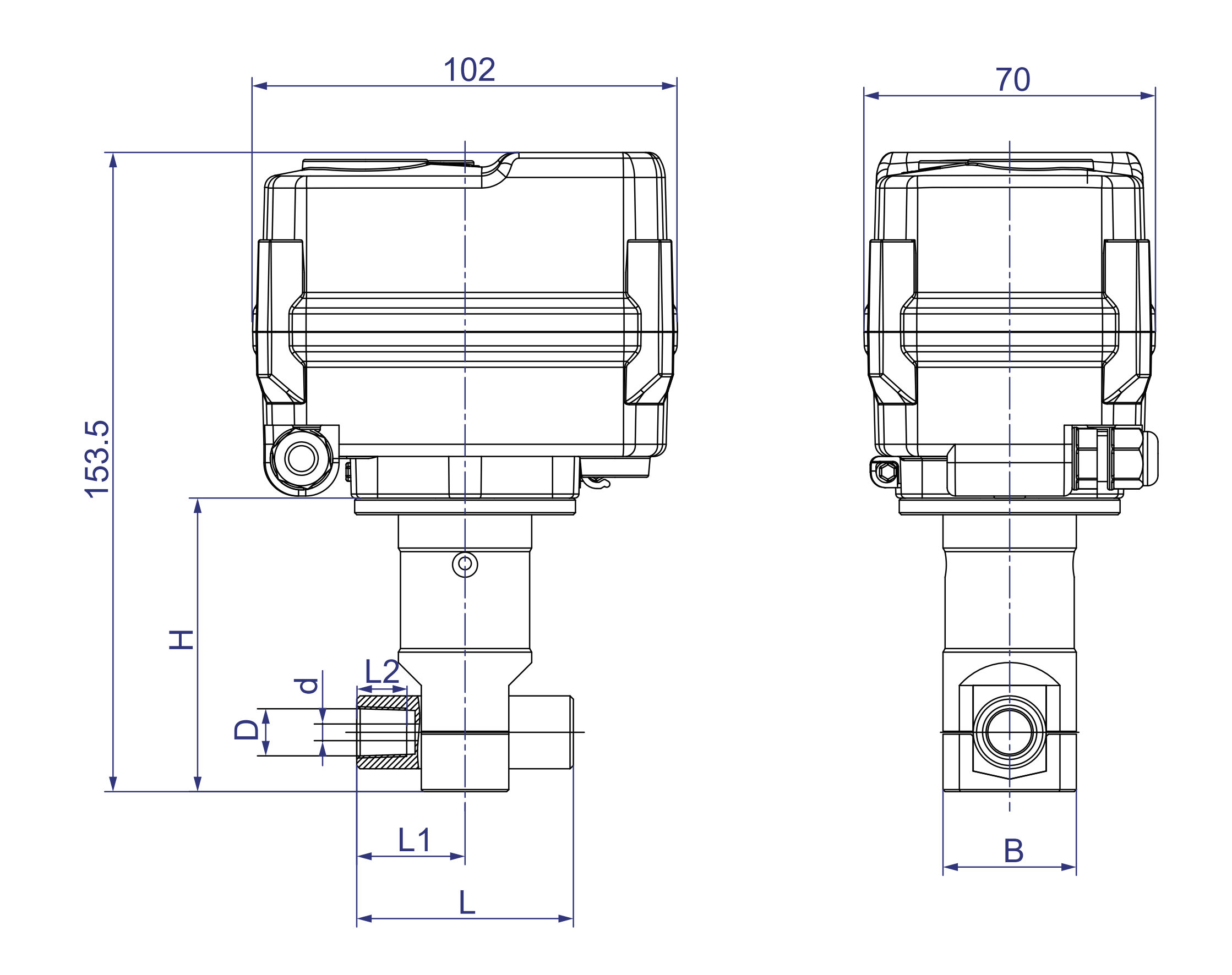
Parameter | KLD200TMT Specification |
|---|---|
Valve Type | Intelligent multi-turn motorized needle valve |
Available Sizes | 1/4", 3/8", 1/2", Φ8, Φ10 |
Valve Body Materials | 304, 316L, 2205 |
Control Inputs | 4–20mA, 0–5V, 1–5V, 0–10V, 2–10V, 0–20mA |
Position Accuracy | ±1%; ±0.5% optional |
Rated Torque | 15 Nm / 20 Nm configurations |
Power Supply | AC/DC24V or AC/DC95–265V, depending on configuration |
Maximum Listed Pressure | 3000 psi at 30°C |
Enclosure Protection | IP67 or damp-proof F-type option |
Ambient Temperature | −15°C to 45°C; other ranges may be customized |
Motor | Brushless motor with overcurrent and overload protection |
Local Interface | OLED display and menu settings |
Alarm Signal | Relay contact output |
The published pressure rating applies under the stated conditions. Actual suitability must be confirmed against the selected valve body, connection, seal materials, temperature, and operating medium.
The stated ±1% and optional ±0.5% values describe positioning performance, not guaranteed fluid flow accuracy.
Several features of the KLD200TMT align with developments in the precision valve market.
Its multi-turn mechanism supports controlled needle positioning. The analog input options allow integration with different industrial control interfaces.
The OLED display helps operators view local information, while the relay alarm output supports monitoring of configured alarm conditions.
The brushless motor and built-in electrical protection are designed to support reliable operation.
For equipment manufacturers, the combination of electronic control, compact construction, and multiple material options can be useful when developing automated low-flow systems.
For detailed dimensions, control options, and specifications, view the KLD200TMT Intelligent Multi-turn Motorized Needle Valve.
KLD has also introduced the product through its Intelligent Multi-turn Modulating Motorized Needle Valve launch announcement, highlighting its precise regulation, intelligent drive, and material options.
Although automation creates opportunities, manufacturers and buyers must address several technical and commercial challenges.
Motorized needle valves generally require additional components compared with manual valves.
These may include an electric motor, control circuit, transmission mechanism, and electrical connections.
As a result, the initial purchase cost can be higher.
The economic value depends on how often the valve must be adjusted, whether remote operation is necessary, and how automation affects operating costs.
An electric valve must be compatible with the existing control system.
Potential challenges include incompatible signal types, incorrect supply voltage, controller configuration, and wiring limitations.
Equipment manufacturers should confirm interface compatibility before specifying the valve.
Integration testing is particularly important when the valve operates as part of a closed-loop process control system.
Precision needle valves may encounter high differential pressures, abrasive particles, aggressive chemicals, or frequent adjustment cycles.
These conditions can affect sealing performance and component life.
A suitable valve specification must account for operating pressure, flow range, fluid compatibility, and expected duty cycle.
For critical installations, additional testing and qualification may be necessary.
Industrial purchasers increasingly require traceable and verifiable product information.
Documentation may include material specifications, dimensional drawings, electrical wiring information, pressure test results, and applicable regulatory declarations.
The requirements vary by industry and project.
For high-purity, medical, or safety-critical applications, standard industrial product documentation may not be sufficient.
The outlook for electric actuated needle valves is linked to the development of precision manufacturing and automated process control.
Three developments are particularly important for future market demand.
Equipment manufacturers are likely to continue adopting electronically adjustable valves in processes where manual settings limit automation.
This creates opportunities for motorized needle valves with repeatable positioning, configurable interfaces, and compact designs.
Standard valves will continue to serve many industrial processes.
However, applications involving small flow rates, aggressive media, and restricted installation space may require specialized needle valve assemblies.
Manufacturers able to provide suitable material combinations and verified performance data may be better positioned for these requirements.
Purchasers may increasingly evaluate how a valve performs within the complete fluid control system.
This includes response time, control stability, maintenance requirements, and compatibility with sensors and controllers.
Future demand is therefore likely to favor suppliers that can support both mechanical valve requirements and electronic integration.
Industrial automation, precise low-flow regulation, and growing demand for electronically controlled fluid systems are important drivers.
One 2026 market forecast estimates a 6.40% CAGR through 2032. This covers the broader needle metering valve market, not electric models alone.
Applications include water treatment, industrial automation, analytical instrumentation, and specialized fluid control equipment.
Yes. Certain models, including KLD200TMT, support 4–20mA analog positioning commands.
They can regulate small fluid passages, but actual dosing accuracy depends on flow measurement, pressure conditions, and system design.
The electric actuated needle valve market in 2026 reflects growing demand for precision, automation, and reliable low-flow regulation. Smart controls, compact designs, and material compatibility will continue to influence product development.
KLD supports these requirements through its modulating valve solutions, including intelligent multi-turn needle valve technology for automated fluid control systems.
For OEM and industrial projects, KLD can help evaluate suitable valve configurations based on application requirements.


