

Views: 0 Author: Site Editor Publish Time: 2026-04-21 Origin: Site


What if the wrong valve choice quietly reduces your system efficiency? Many setups fail not because of poor equipment, but because of choosing the wrong 2 way and 3-way ball valve. This small decision can impact flow control, cost, and long-term reliability.
This article focuses on the real difference between a 2 way and 3-way ball valve. It explains how they work, how their functions differ, and where each type fits best in practical systems.In this article, you will learn how to compare valve types, understand flow control options, and choose the right solution based on your system needs.
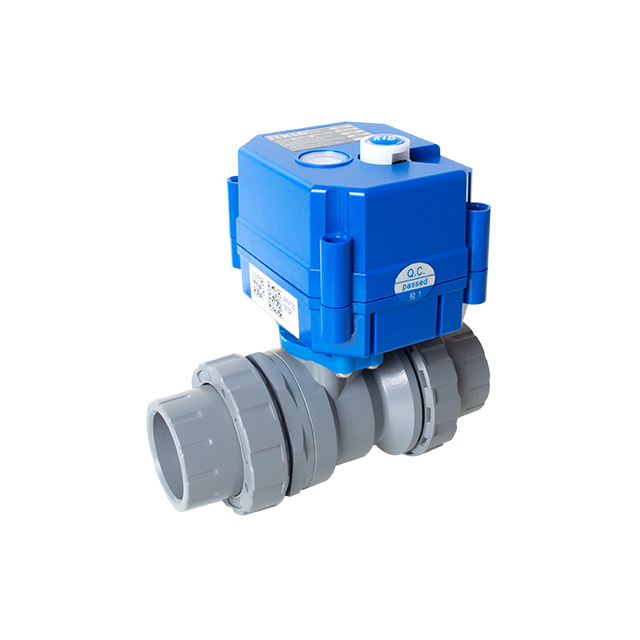
A 2 way and 3-way ball valve comparison starts with the simplest structure. A 2 way ball valve is built for direct flow control, allowing fluid to move in one straight path or stop completely. Inside the valve, there is a solid ball with a drilled hole. When the valve handle or actuator turns the ball, the hole either aligns with the pipeline or blocks it. This simple rotation controls whether fluid flows or not.
In terms of structure, the design includes only two ports. One is the inlet, and the other is the outlet. Because of this straight-through configuration, the internal flow path remains smooth, which helps reduce pressure loss during operation. It works efficiently in systems where flow does not need to change direction. In real installations, this type of valve is often used because it is easy to install and does not require complex piping layouts.
The operation is also very intuitive. A quarter-turn movement opens or closes the valve, which makes it fast and reliable. This is especially useful in automated systems where response time matters. Many modern solutions, including those from KLD, combine this simple valve structure with compact electric actuators. This improves control accuracy while keeping the overall system compact and efficient.
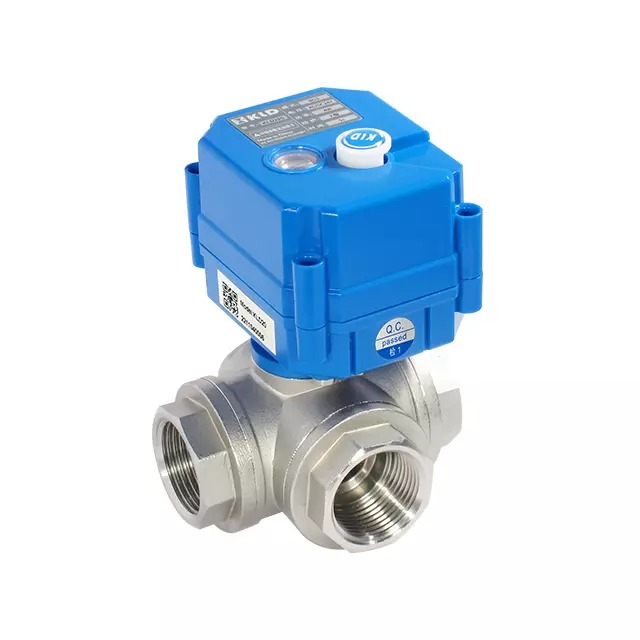
A 3-way ball valve builds on the same basic concept but introduces more flexibility. Instead of two ports, it includes three, which allows fluid to move in multiple directions. This means the valve can redirect flow from one pipeline to another or even combine flows from different sources. Because of this, it is commonly used in systems where control needs go beyond simple on and off functions.
Internally, the ball structure is more complex. It contains specially designed passages that determine how fluid moves through the valve. Depending on the design, the valve can switch flow between outlets or allow mixing. This makes it a practical choice for systems that require dynamic control rather than fixed flow paths. In many cases, using a single 3-way valve can replace multiple 2 way valves, which helps simplify piping and reduce installation effort.
From an operational perspective, it still uses a quarter-turn rotation. However, each position of the valve changes the connection between ports. This creates different flow paths within the same unit. In automated setups, this flexibility becomes even more valuable. KLD integrates motorized control into these valves, offering stable switching performance and long service life in demanding environments.
Understanding flow behavior is the first step when comparing a 2 way and 3-way ball valve. A 2 way ball valve supports a single straight flow path. Fluid enters through one port and exits through another, without any change in direction. This makes it suitable for basic control tasks where only opening or closing is required.
A 3-way ball valve introduces a different level of control. Instead of a fixed path, fluid can be redirected or combined depending on the valve position. This allows more flexible system design, especially in applications involving multiple pipelines or dynamic flow requirements.
Flow Direction Control:
A 2 way ball valve maintains a single, uninterrupted flow path. This ensures stable pressure and minimizes turbulence in the pipeline. In many systems, this simplicity improves reliability and reduces the chance of operational errors.
A 3-way ball valve supports multiple flow paths. Flow can be switched between outlets or directed into different lines, which reduces the need for additional valves and piping components.
Functional Capability:
A 2 way valve performs only on/off control. This makes it ideal for isolation tasks where precise flow routing is not required.
A 3-way valve allows diverting or mixing functions. This makes it suitable for applications such as temperature control, fluid blending, or switching between sources.
| Flow Feature | 2 Way Ball Valve | 3-Way Ball Valve |
|---|---|---|
| Flow Direction | Single path | Multiple paths |
| Function | On/Off control | Diverting / Mixing |
| System Flexibility | Limited | High |
| Typical Use | Isolation, shut-off | Switching, blending, distribution |
The internal structure of a 3-way ball valve determines how fluid moves between ports. Unlike the simple straight bore found in a 2 way valve, a 3-way valve uses specially shaped passages. These designs define whether the valve switches flow or mixes it.
L-Port Design Overview:
L-port valves connect two ports at a time, allowing flow to switch between different outlets. This design is often used when one input needs to alternate between two outputs.
The internal passage resembles an “L” shape, which limits flow to one direction at a time. This prevents mixing and keeps flow paths clearly separated.
T-Port Design Overview:
T-port valves allow three ports to connect simultaneously. This enables mixing or splitting of flow, depending on system requirements.
The internal passage forms a “T” shape, which allows fluid to move across multiple directions within the same valve body.
Selection Considerations:
L-port valves are better for switching applications where flow direction changes but does not mix.
T-port valves are suitable for systems requiring fluid blending or distribution across multiple lines.
Many motorized valve designs, including those developed by KLD, support both configurations to meet different control needs while maintaining compact size and long service life.
Cost and complexity often influence the decision between a 2 way and 3-way ball valve. A 2 way valve has a simpler structure, which reduces manufacturing cost and makes installation easier. Fewer internal components also mean lower maintenance requirements over time.
A 3-way valve involves a more advanced design. Additional ports and internal passages increase both production cost and installation complexity. However, this complexity can reduce the total number of valves needed in a system, which may offset the initial investment.
Cost Structure Factors:
A 2 way valve typically has a lower upfront cost due to its simple design. This makes it a common choice for basic systems.
A 3-way valve has a higher unit cost, but can reduce system-level expenses by replacing multiple valves and simplifying piping layouts.
Installation Complexity:
A 2 way valve is easy to install, requiring only two pipeline connections. This reduces installation time and labor.
A 3-way valve requires careful alignment of ports and correct configuration selection. Incorrect installation can lead to flow issues or reduced efficiency.
Maintenance Considerations:
A 2 way valve has fewer moving parts, which reduces the risk of wear and simplifies maintenance procedures.
A 3-way valve requires more attention due to its internal complexity, but advanced designs improve durability. KLD motorized valves, for example, are engineered for long service life and stable operation, even in demanding environments.
A 2 way and 3-way ball valve comparison becomes clearer when looking at real applications. A 2 way ball valve is widely used in systems where flow control remains simple and predictable. The straight-through design allows fluid to move efficiently, which helps maintain stable system performance over time.
In many installations, a 2 way valve acts as a reliable shut-off component. Its simple operation reduces the chance of failure and keeps maintenance requirements low. This makes it suitable for both residential and industrial environments where reliability matters more than flexibility.
Water Supply Systems:
A 2 way valve is often installed in water pipelines to control supply flow. It allows quick shut-off during maintenance or emergency situations.
The simple internal structure helps reduce pressure loss, which improves overall system efficiency.
HVAC and Pipeline Isolation:
Heating and cooling systems rely on 2 way valves to isolate specific sections of the pipeline. This allows maintenance without shutting down the entire system.
Stable sealing performance ensures long-term operation, especially in temperature-sensitive environments.
Industrial Fluid Control:
Basic industrial processes use 2 way valves for controlling oil, gas, or chemical flow. The straightforward design supports consistent performance in continuous operation.
Compact motorized versions, such as those developed by KLD, allow integration into automated control systems without increasing installation complexity.
A 3-way ball valve is designed for systems that require more than simple on/off control. The additional port allows fluid to change direction or combine flows, which expands the range of possible applications. This flexibility becomes essential in systems where multiple pipelines interact.
Complex industrial processes often rely on 3-way valves to reduce the number of components. Instead of installing several 2 way valves, a single 3-way valve can handle switching or mixing tasks, which simplifies system design.
Flow Diversion Systems:
A 3-way valve is used to redirect flow between different pipelines. This is common in systems where fluid needs to be routed to different destinations based on operating conditions.
The ability to switch flow paths reduces the need for additional valves and minimizes installation space.
Mixing and Blending Processes:
In applications such as temperature control or chemical processing, a 3-way valve allows two fluid streams to combine. This enables precise control over output conditions.
T-port configurations are especially useful in these scenarios, as they support simultaneous flow connections.
Multi-Line Control Systems:
Industrial automation systems often require control over multiple pipelines. A 3-way valve simplifies this by managing several flow paths within a single unit.
Motorized designs improve responsiveness and allow integration with control systems for real-time adjustments.
Choosing between a 2 way and 3-way ball valve depends on how the system is designed and what level of control is required. Different scenarios require different solutions, and selecting the wrong type can lead to inefficiency or unnecessary cost.
System Complexity Consideration:
A simple pipeline system benefits from a 2 way valve because it only requires basic flow control. Adding a 3-way valve in this case increases cost without providing additional value.
A complex system, especially one involving multiple pipelines, often requires a 3-way valve to manage flow direction or mixing functions.
Automation vs Manual Control:
Manual systems typically use 2 way valves due to their ease of operation and lower cost. The straightforward design works well when automation is not required.
Automated systems benefit from 3-way valves, as they allow more advanced control strategies. KLD motorized valves support this by offering stable performance and flexible configurations.
Space and Piping Considerations:
Limited installation space often favors 3-way valves because they reduce the number of components needed. A single valve can replace multiple connections, simplifying layout design.
Larger systems with enough space may use multiple 2 way valves instead, especially when cost control is a priority.
In real-world applications, the decision usually comes down to balancing simplicity and functionality. Each valve type serves a clear purpose depending on system requirements.
Selecting the right 2 way and 3-way ball valve starts from understanding the actual system demand. Many users focus only on valve type, but real performance depends on how well the valve matches flow conditions and operating environment. A wrong choice can lead to unstable flow, pressure loss, or unnecessary cost.
Flow Requirement Matching:
A system requiring simple shut-off should use a 2 way valve. Flow remains stable, control logic stays clear, and operation becomes easy to manage over time.
A system requiring switching or mixing must use a 3-way valve. Flow paths change based on operating conditions, which improves flexibility in multi-line systems.
In many projects, selecting a 3-way valve only makes sense when multiple flow paths exist. Otherwise, a 2 way valve provides better efficiency at lower cost.
Pressure and Media Compatibility:
Valve material must match the working medium. Stainless steel suits corrosive fluids, while brass or PVC works better in standard water systems.
Temperature and pressure ratings must align with system conditions. Incorrect selection can shorten valve lifespan or cause leakage.
KLD valves are designed to support a wide range of environments, including high-pressure and temperature-sensitive applications.
System Complexity Consideration:
Simple pipelines benefit from fewer components. A 2 way valve reduces installation difficulty and maintenance effort.
Complex systems require flexible flow control. A 3-way valve simplifies piping by reducing the number of valves needed.
| Selection Factor | 2 Way Ball Valve | 3-Way Ball Valve |
|---|---|---|
| Flow Requirement | On/Off control | Switching / Mixing |
| System Complexity | Simple systems | Multi-line systems |
| Media Compatibility | Standard fluids | Complex process fluids |
| Cost Efficiency | Lower initial cost | Higher, but reduces system components |
Automation plays an important role in modern valve selection. A 2 way and 3-way ball valve can both be equipped with electric actuators, but the purpose differs depending on system requirements. Automation improves control precision and reduces manual intervention, especially in large-scale or continuous operations.
When to Use Electric Actuators:
Systems requiring remote control or scheduled operation benefit from motorized valves. This allows real-time adjustments without manual operation.
Environments where access is limited or unsafe also require automated solutions. Electric actuators improve safety and reliability.
Compact actuator designs, such as those used by KLD, support installation in tight spaces while maintaining stable performance.
Benefits of Automated Valve Control:
Improved accuracy in flow control, especially in systems requiring frequent adjustments.
Faster response time compared to manual operation, which enhances system efficiency.
Long service life through optimized motor design and sealing technology, reducing downtime and maintenance frequency.
Integration with Control Systems:
Modern valves can connect to PLC or building automation systems, enabling centralized control.
Features such as fail-safe positioning, LED indication, and alarm signals improve system monitoring.
Flexible voltage compatibility ensures use across different regions and industrial standards.
Choosing the wrong 2 way and 3-way ball valve often leads to performance issues or unnecessary expenses. Many selection mistakes come from focusing only on valve type without considering system requirements in detail.
Over-Specifying Valve Type:
A 3-way valve is sometimes selected even when only basic flow control is needed. This increases cost and adds unnecessary complexity to the system.
A 2 way valve may be insufficient in systems requiring flow switching, leading to poor performance or redesign.
Incorrect Port Configuration:
Selecting the wrong internal design, such as using an L-port when mixing is required, can cause system malfunction.
Proper understanding of flow direction and valve position is essential before installation.
Ignoring Long-Term Maintenance Needs:
Complex valves require more attention during maintenance. Choosing a valve without considering service conditions may increase downtime.
High-quality motorized valves, such as KLD products, reduce maintenance frequency due to durable design and long operating cycles.
Careful evaluation of these factors ensures the valve performs as expected in real applications, avoiding unnecessary adjustments after installation.
Choosing between a 2 way and 3-way ball valve depends on flow needs and system design. KLD provides both 2 way and 3-way motorized ball valves designed for reliable automation. Their compact structure saves installation space and supports flexible system layouts. Advanced motor and sealing technology ensure long service life and stable operation. These features help users achieve efficient control while lowering maintenance needs across different industries.
A: A 2 way and 3-way ball valve controls flow. One shuts off flow, the other redirects or mixes it.
A: Use a 3-way ball valve when flow must switch or mix between pipelines.
A: A 2 way and 3-way ball valve is not always interchangeable because functions differ.
A: A 3-way ball valve usually costs more due to complex design and added function.
A: A 2 way and 3-way ball valve can use electric actuators for automated control.


